


Blog
Nigerian Bridal Jewelry: A 2026 Guide for the Modern Bride

The Bridal Jewelry Decision Most Nigerian Brides Quietly Regret
Here’s the pattern that shows up in almost every honest post-wedding conversation with a Nigerian bride.
She spent months on the dress. She had six meetings with her makeup artist. She debated florists, photographers, and cake designers for weeks. Then, somewhere in the final month before the wedding, someone said “what about jewelry?” — and she picked pieces in an afternoon that she still remembers as an afterthought.
Two years later, those pieces sit in a box she rarely opens. They photographed fine. They didn’t embarrass her. But they don’t feel like her. And she never wears them.
This is the single most common regret among Nigerian brides who plan sophisticated weddings otherwise. And it’s the reason we’re writing this guide.
Nigerian bridal jewelry deserves the same intentionality as every other wedding decision. It appears in every photograph. It shows up in every video clip your makeup artist posts for the next two years. Long after the dress hangs in a closet and the shoes are forgotten, the pieces around your neck and on your ears become part of how you remember the day — and how everyone else remembers seeing you.
This is the modern Nigerian bride’s framework: how to choose jewelry you’ll still love at your tenth anniversary.
What’s Changed About Nigerian Bridal Jewelry in 2026
Nigerian bridal jewelry has shifted more in the past five years than in the previous twenty. Coverage on BellaNaija Weddings has consistently documented these changes, and they’re worth naming clearly.
- The heavy matching set has quietly retired. The default of a decade ago — a single matching set of statement necklace, earrings, and bangles in yellow gold — has been replaced by curated combinations. Brides today mix pieces intentionally rather than defaulting to a pre-packaged set.
- Ethnicity meets modernity. Nigerian brides increasingly honour traditional pieces (coral for Igbo brides, aso-oke coordination for Yoruba brides, elaborate sets for Edo brides) while pairing them with modern designed pieces from curated brands. The two conversations sit alongside each other rather than competing.
- Photography rules everything. Between wedding photographers, videographers, and social media, the modern Nigerian bride’s jewelry is photographed hundreds of times. Pieces that photograph well have become non-negotiable.
- Post-wedding wearability matters. Increasingly, brides choose bridal jewelry with the deliberate question: “Will I wear this again?” Sets that break apart into everyday pieces have become genuinely popular.
- Curated boutique brands have replaced generic sellers. The Instagram vendor era is being overtaken by hybrid brands with physical stores, verified craftsmanship, and clear return policies.
This shift is part of a broader movement across African luxury fashion — younger buyers rejecting mass-produced luxury in favour of considered, culturally-rooted design. Nigerian brides are at the front of this shift.
The Three-Look Framework Every Nigerian Bride Should Understand
Almost every Nigerian wedding involves at least three distinct jewelry stories. Understanding the framework helps you plan intentionally rather than reactively.
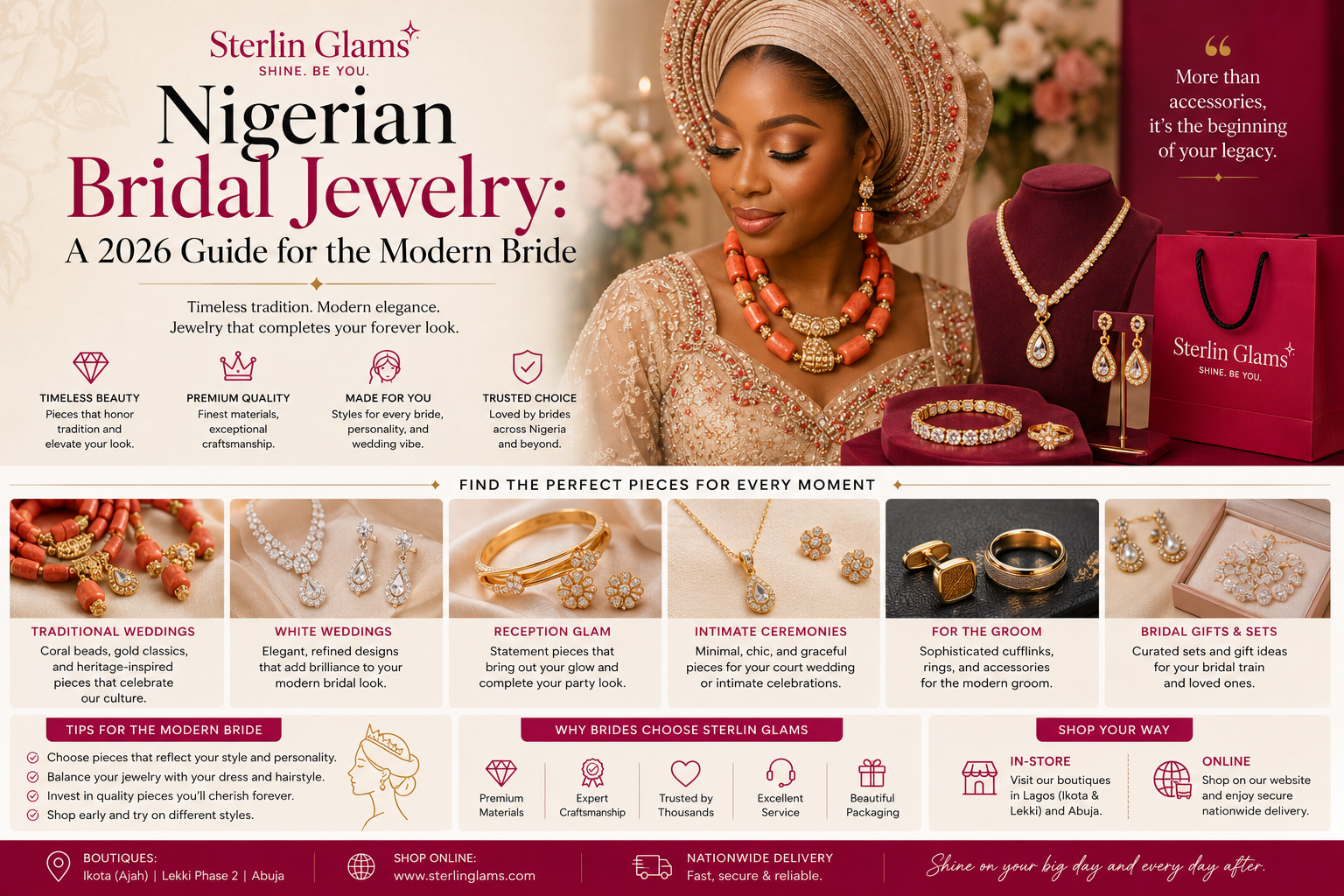
The Traditional Wedding Look
The heaviest jewelry moment of the wedding. Cultural pieces dominate — coral, elaborate gold, ceremonial beads — coordinated with aso-oke, george, or traditional attire. Family often plays a role in providing or advising on pieces. This is where cultural specificity matters most, and where ethnicity-specific guidance is essential.
The White Wedding Look
The most photographed moment of the wedding. Elegant, refined jewelry that complements the dress without competing with it. The rule most modern brides follow: one hero piece, refined supporting pieces, coordinated bracelets, hands and ears carefully considered because they photograph most.
The Reception Look
The most expressive moment. The bride finally exhales, the photographs are mostly captured, and the pieces here get to have more fun. Bold statement earrings, layered necklaces, expressive rings. Often the reception jewelry is what the bride wears again long after the wedding.
Each of the three looks deserves its own jewelry story. Trying to make one set work for all three is where regrets begin.
Ethnic Traditions in Nigerian Bridal Jewelry: A Brief Overview
Nigerian bridal jewelry is not one tradition. It’s dozens. Each ethnic group has its own specific pieces, cultural rules, and coordination expectations. This guide is the framework; specific ethnicity guides go deeper.
Yoruba Bridal Jewelry
The Yoruba bride wears jewelry across multiple wedding events — introduction, engagement, and often a separate white wedding day. Gold dominates, with pieces coordinated to aso-oke, gele, and family colours. Our Yoruba bridal jewelry guide covers this in depth, including the specific pieces required for each event and how to coordinate with gele and aso-oke.
Igbo Bridal Jewelry
Coral is the centrepiece of Igbo bridal tradition — worn heavily during the traditional wedding, often in elaborate strands around the neck, wrists, and headpiece. Modern Igbo brides increasingly pair coral with contemporary Nigerian designer pieces for a look that honours tradition without being locked into it. A dedicated Igbo bridal guide is planned for the coming weeks in this series.
Hausa and Fulani Bridal Jewelry
Northern Nigerian bridal traditions feature gold, silver, and coral in bridal contexts, with pieces designed to complement traditional attire and hijab styling. Intricate craftsmanship rooted in centuries-old traditions defines the aesthetic.
Edo Bridal Jewelry
Among the most jewelry-heavy Nigerian bridal traditions. Coral and gold pieces designed for Edo weddings are elaborate, distinctive, and often family-provided rather than newly purchased. The Edo bride’s jewelry is one of the most visually striking Nigerian bridal styles.
Efik, Ibibio, and Cross River Bridal Jewelry
Coral and beaded traditions dominate. Ceremonial pieces are particular to specific ceremonies and often coordinated across the bridal party.
Universal principle across all Nigerian bridal traditions: your family’s specific customs should always guide your choices. Consult with mothers, aunts, and family elders before making major purchases, especially for the traditional wedding.
What to Prioritise When Shopping for Nigerian Bridal Jewelry
Modern Nigerian brides who love their bridal jewelry years later almost always prioritised these things during shopping:
- Photography-friendly design. Test with your phone camera in the store. If a piece disappears in photos, it’s too delicate. If it overwhelms, it’s too much. The right piece catches light without dominating.
- Comfort for long-day wear. A traditional wedding runs six to eight hours. A white wedding day runs longer. Earrings that hurt by 2pm ruin the entire second half of your day.
- Post-wedding wearability. Ask yourself: would I wear this to my sister’s wedding in three years? To my anniversary dinner? To a Christmas service? Pieces you’d wear again justify their price differently.
- Cultural appropriateness. Consult your family. What are your specific customs? What did your mother wear? What are your in-laws’ expectations? Some conversations must happen before shopping, not after.
- Scale that matches the outfit. A delicate chain disappears against a heavily embellished traditional outfit. A massive statement necklace fights a beaded dress bodice. Match jewelry weight to outfit weight.
Budget Planning for Nigerian Bridal Jewelry
Bridal jewelry budgets in Nigeria vary dramatically — from a few hundred thousand naira for a curated boutique bridal look to millions for elaborate traditional pieces or investment-grade gold. There’s no single right budget. There’s only the budget that fits your specific wedding, family expectations, and long-term plans.
A few principles that apply regardless of budget size:
- Invest most in the piece you’ll wear most. This is usually reception or white wedding jewelry — the pieces that transition beyond the wedding day. Not the traditional pieces you may only wear once.
- Save on ceremonial pieces where possible. Traditional pieces that will only ever be worn during your wedding week can sometimes be borrowed, rented, or family-provided. Coral, in particular, is often family heirloom material.
- Don’t cut costs on the pieces that appear in your close-up photographs. Rings, earrings, and hand-adjacent bracelets show in more frames than you’d think. Quality here shows in every wedding album.
- Set the budget before you browse. Bridal jewelry shopping is emotional. A pre-decided ceiling keeps decisions clear.
The Bridal Jewelry Timeline: When to Do What
Most Nigerian brides leave jewelry shopping too late. Here’s the timeline that saves regret:
- 6+ months out: Start browsing. Don’t buy yet. Understand what’s available across brands and styles. Save Instagram references. Talk to your family about specific cultural requirements.
- 3-4 months out: Make your traditional wedding jewelry decisions. These often need to be ordered, held, or coordinated with family provided pieces.
- 2-3 months out: Decide your white wedding jewelry. Book consultations at boutique brands you’re considering. Bring your dress fabric swatches if possible.
- 6-8 weeks out: Finalise reception pieces. Coordinate any bridal train jewelry. Confirm delivery timelines with vendors.
- 2 weeks out: Final fittings with all jewelry on. Wear with your trial makeup and hair. Test comfort levels — a piece that hurts during a 30-minute trial will hurt more during an 8-hour wedding.
Every bride who’s ever bought her bridal jewelry a week before the wedding knows the feeling of settling. Give yourself time.
Where to Buy Bridal Jewelry in Nigeria
Every major channel plays a role in the Nigerian bridal jewelry landscape. Our national buyer’s guide covers the full framework. For bridal specifically:
- Curated boutique brands. The strongest choice for modern Nigerian brides. Handmade quality, transparent pricing, in-store consultations, and pieces designed to work across occasions. Best for white wedding and reception jewelry.
- Traditional gold sellers. For classic gold wedding pieces — bangles, wedding gold, ceremonial gold. Best approached with an experienced family member.
- Specialty vendors. For coral, beads, and ethnicity-specific ceremonial pieces. Often better than mainstream retail for these categories.
- Custom orders. Some boutique brands offer bespoke work. Best for brides with very specific visions that off-the-shelf pieces don’t match.
The strongest overall approach: consolidate to one or two trusted brands for the majority of your bridal jewelry, then use specialty vendors for the specific traditional pieces they excel at. Sterlin Glams occupies the curated boutique tier — our stores in Ikeja, Ikota, and Abuja offer bridal consultations, and our online catalogue at sterlinglams.com lets you browse before visiting.
Bridal Sets vs. Individual Pieces: The Modern Bride’s Choice
A quiet decision that shapes everything else.
Bridal sets — matching necklace, earrings, and often bracelets or bangles — have been the Nigerian default for decades. They’re convenient. They coordinate perfectly. And they’ve quietly held brides back.
The problem with the traditional set: you buy three pieces, wear them once as a set, and never wear them again because the set only works together. Break the set and no piece stands alone. This is the mathematics behind post-wedding jewelry regret.
The modern alternative: sets that break apart. Bridal pieces designed to work together for the wedding day but also stand alone afterward. The earrings you can wear to weekend dinners. The necklace you can wear to your best friend’s engagement party. The bracelet that becomes an everyday piece. Our sets collection leans heavily toward this approach.
Ask this question before buying any bridal set: “Which of these pieces would I wear on its own in three years?” If the answer is “none,” reconsider.
Common Nigerian Bridal Jewelry Mistakes (And How to Avoid Them)
Mistake 1: Buying jewelry before the dress is finalised. Wait until the dress is in your hands. Jewelry proportion, style, and colour all depend on the outfit.
Mistake 2: Skipping the trial. Every bridal jewelry piece should be tried on with your trial makeup and hair. Big lashes change how earrings sit. Elaborate updos change how necklaces frame the face.
Mistake 3: Trusting Instagram-only sellers with major purchases. Bridal jewelry is not the moment to discover a new online-only vendor. Buy from brands you can visit, verify, and return to.
Mistake 4: Buying only for the wedding photos. The most photographed jewelry isn’t always the jewelry you’ll cherish. Balance photograph readiness with personal taste.
Mistake 5: Ignoring family customs. Some cultural expectations aren’t optional. Consult family elders early — before you’ve fallen in love with pieces that won’t suit your tradition.
Mistake 6: Forgetting the bridal train. Coordinating (not matching) with your maid of honour or chief bridesmaid creates beautiful photograph moments. Plan this into your jewelry budget.
Mistake 7: Prioritising set matching over personal fit. A perfectly matching set that doesn’t suit your face is worse than three considered separate pieces that do.
Where Sterlin Glams Fits for Nigerian Brides
We serve modern Nigerian brides who value handmade quality, transparent pricing, and jewelry designed to be worn beyond the wedding. Our bridal sets collection leans toward pieces that break apart into wearable individual items. Our necklaces, earrings, bracelets, and rings work well as reception pieces or in coordination with traditional attire.
Bridal consultations are available at all three stores — Ikeja, Ikota, and Abuja. We recommend booking in advance so we can dedicate proper time to walking you through pieces. Call 0806 425 0597 to arrange. If you’re shopping from outside our store cities, our online catalogue at sterlinglams.com ships nationwide, and our team is available on WhatsApp to answer questions before you order.
We don’t claim to be the only good bridal jewelry choice for Nigerian brides. What we offer is the specific combination that suits considered brides: handmade design, verified quality, transparent pricing, and a shopping experience that respects the size of the decision you’re making.
The Pieces You’ll Still Love at Your Tenth Anniversary
Here’s a truth that shapes every recommendation in this guide: the most photographed jewelry isn’t always the jewelry you’ll cherish.
The bride who chose a dramatic set for maximum wedding day impact sometimes never wears it again. The bride who chose slightly more restrained, more personal pieces — jewelry that reflected her actual taste rather than wedding-day performance — keeps wearing them. To anniversaries. To dinners. To her sister’s wedding three years later. To Christmas. To her daughter’s christening.
Nigerian bridal jewelry should photograph well. That matters. But it should also feel like you — the version of you that will still exist in ten years, in twenty years, at your fiftieth birthday celebration.
The pieces you’ll reach for in five years and smile at are the pieces worth the investment. Everything else is inventory. The upcoming posts in this bridal series will go deeper on ethnicity-specific traditions — starting with the Yoruba bridal jewelry guide next week, then Igbo bridal jewelry, then wedding rings in Nigeria. Each builds on this framework.
Ready to start your bridal jewelry planning? Browse the Sterlin Glams bridal sets and full jewelry collection online, or book a bridal consultation at our Ikeja, Ikota, or Abuja store. Call 0806 425 0597.
Frequently Asked Questions
How much should I budget for Nigerian bridal jewelry?
Bridal jewelry budgets vary dramatically. Curated boutique brand bridal looks range widely depending on pieces chosen. Traditional gold and ceremonial pieces can be significant additional investments. The most important budgeting principle: decide your ceiling before browsing, invest most in the pieces you’ll wear beyond the wedding, and save on pieces you’ll only ever wear once.
How early should I start shopping for bridal jewelry in Nigeria?
Start browsing 6+ months out. Make major decisions 3-4 months out. Finalise all pieces 6-8 weeks out. Trial with makeup and hair 2 weeks out. Shopping later than this leads to compromises brides usually regret.
Should I buy a bridal set or individual pieces?
For modern Nigerian brides, individual pieces that coordinate but can be worn apart usually make better long-term investments than traditional matching sets. Sets that break apart into wearable individual pieces offer the best of both worlds — coordinated for the wedding, wearable individually afterward.
What’s the difference between traditional wedding jewelry and reception jewelry?
Traditional wedding jewelry tends to be more elaborate, culturally specific, and heavier — designed to complement traditional attire like aso-oke, george, or coral. Reception jewelry is typically more personal, expressive, and often reflects the bride’s post-wedding wearable taste. Most Nigerian weddings involve at least these two distinct jewelry stories, plus often a white wedding look between them.
Can I shop for Nigerian bridal jewelry online?
For statement bridal pieces, in-store shopping is strongly recommended so you can try pieces on, see how they photograph, and confirm comfort. For coordinating pieces (bracelets, accent earrings, layering chains), online works well. Hybrid brands with both online catalogues and physical stores offer the best of both — browse first, visit for major decisions.
Do Nigerian bridal jewelry brands offer consultations?
The best ones do. Curated boutique brands like Sterlin Glams offer bridal consultations at physical stores — usually free, usually by appointment. Bring dress fabric samples, hair reference photos, and any family-provided pieces you’re coordinating with. Book 4-6 weeks before your target purchase date.
Related Posts
Where to Buy Jewelry in Nigeria: A 2026 Buyer’s Guide Across Cities, Categories, and Channels

Every Nigerian Jewelry Shopper Has Faced the Same Question
Where should I actually buy this?
Not just which city. Which tier. Online or in-store. Traditional gold market or curated brand. Mass-market or handmade. Established name or emerging designer. The question multiplies the closer you get to spending real money on a piece.
For a country of over 200 million people spread across dozens of cities, each with its own jewelry culture, retail traditions, and price expectations, the Nigerian jewelry buying decision is more complex than most guides admit.
This is the national buyer’s framework — designed for anyone anywhere in Nigeria who has money to spend on jewelry and wants to spend it well. Whether you’re in Lagos, Abuja, Port Harcourt, Kano, Enugu, or Nigerian and shopping from the diaspora, this guide gives you the vocabulary to make good decisions.
The Nigerian Jewelry Retail Landscape in 2026
Nigerian jewelry retail has changed more in the last five years than in the previous twenty. Analysis on Vogue Business has repeatedly identified Nigeria as one of the fastest-growing luxury markets in Africa, and the Nigerian e-commerce sector has matured to the point where buying jewelry online across states is now genuinely reliable.
Four shifts define the current landscape:
- Curated Nigerian brands have gone mainstream. Handmade, considered design brands with national reach have replaced generic mall retail as the aspirational choice.
- E-commerce infrastructure has matured. Payment processors, logistics networks, and consumer protection have caught up with international standards.
- Traditional gold markets remain active. Balogun, Idumota, Kano’s traditional gold streets, and smaller markets in older cities continue to serve buyers who want gold by weight.
- Hybrid brands dominate the informed buyer’s mind. Brands with both physical stores and online catalogues have replaced online-only or offline-only brands as the trusted default.
What this means practically: you have more options than ever, but you also need a better framework than ever to choose between them.
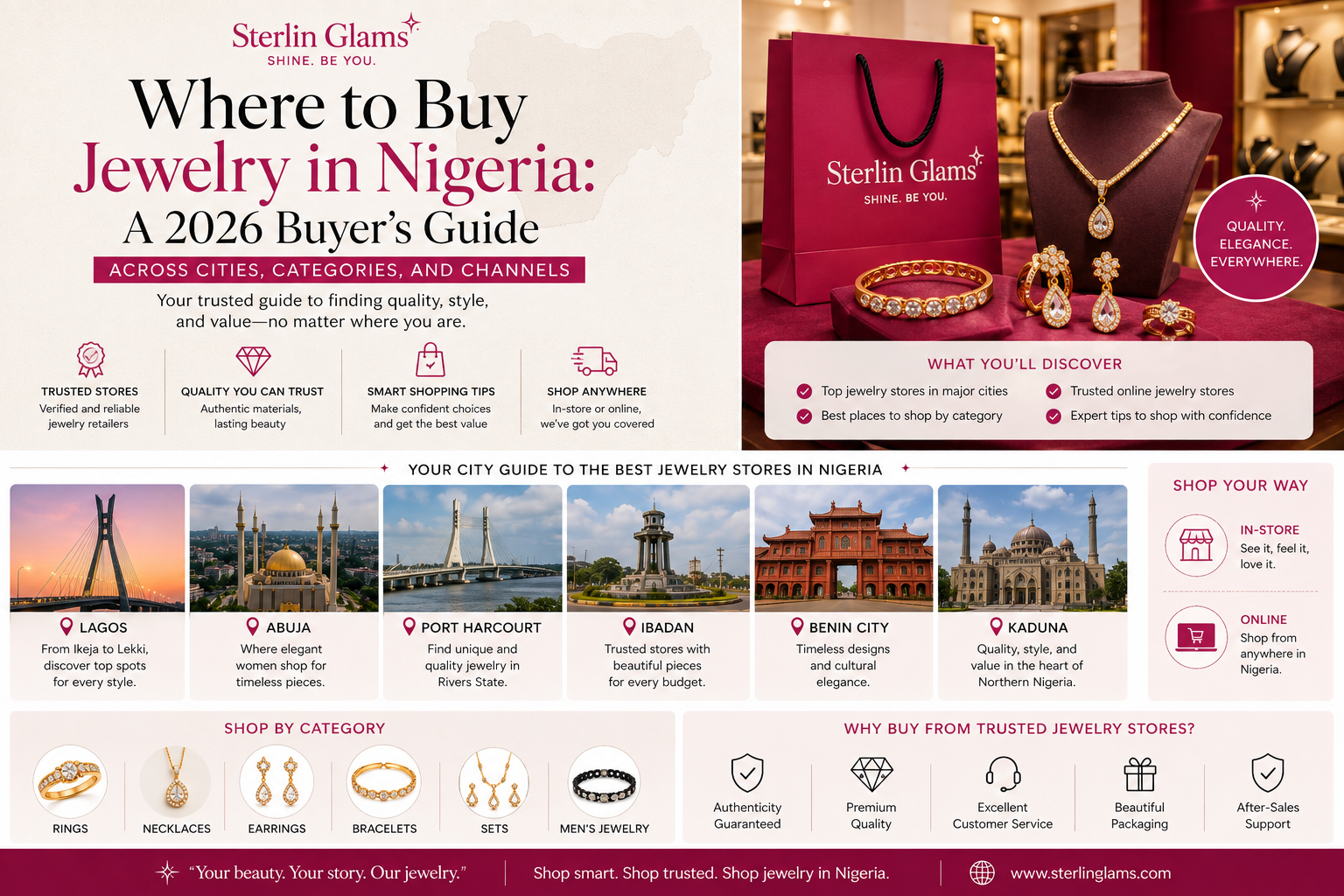
The Cities Where Nigerian Jewelry Is Sold — And How They Differ
Nigerian jewelry retail is unevenly distributed. Some cities have dense, sophisticated jewelry retail. Others are still building. Knowing what each city offers saves wasted trips.
Lagos
The country’s undisputed jewelry retail capital. Lagos has more jewelry stores per square kilometre than any other Nigerian city, spread across four distinct sub-markets: Ikeja, Ikota/Lekki Phase 2, Lekki Phase 1, and Victoria Island. Each has its own personality. Our Ikeja jewelry guide and Ikota & Lekki Phase 2 jewelry guide cover the mainland and eastern corridor in depth. Traditional gold sellers still dominate Balogun and Idumota on Lagos Island. What Lagos offers that no other city matches: range across every tier, every price point, and every cultural style.
Abuja
The capital’s jewelry retail personality is refined, understated, and diplomatic. Wuse 2, Maitama, and the Central Area anchor the retail landscape. Abuja shopping culture rewards patience and relationship-building more than any other Nigerian city. Our Abuja jewelry stores guide covers the city’s neighborhoods and shopping culture in detail. What Abuja offers that Lagos doesn’t: a calmer, more considered shopping experience with less noise, less traffic, and more room for staff to actually spend time with you.
Port Harcourt
Port Harcourt jewelry culture is bold and statement-forward. The city’s oil-economy history has produced a jewelry retail sensibility that rewards presence, sparkle, and dimension. Stoned sets, heavier gold, and dramatic pieces sell better here than in Lagos or Abuja. Retail concentrates around Aba Road, GRA, and the Trans Amadi area.
Enugu, Owerri, and Aba
The heart of Igbo jewelry culture. Coral bridal pieces, traditional wedding gold, and Igbo-specific ceremonial jewelry are best sourced here. Aba in particular has a long history of jewelry production, and smaller boutique brands increasingly ship from Aba to buyers across Nigeria.
Kano, Kaduna, and the North
Northern Nigerian jewelry culture has its own traditions, particularly around Hausa and Fulani bridal jewelry, coral, silver, and gold pieces designed to be worn with traditional attire. Kano’s traditional gold streets remain active. Kaduna offers a smaller but growing retail scene.
Benin City
The traditional centre of Edo bridal jewelry — coral and gold pieces designed for Edo weddings, which are among the most jewelry-heavy cultural ceremonies in Nigeria. Specialty vendors here dominate the traditional Edo bridal market.
Ibadan
Growing retail. The traditional Yoruba jewelry culture is well-served here, and newer curated brands have started opening as Ibadan’s professional class expands. Bodija and Ring Road anchor the retail landscape.
How Regional Cultures Shape Nigerian Jewelry Preferences
One of the most under-discussed aspects of buying jewelry in Nigeria is how regional culture shapes what people actually wear. A piece that dominates in Lagos might feel out of place in Kano. A traditional wedding set that’s perfect for an Igbo bride would confuse a Yoruba one. Coverage on BellaNaija Weddings consistently documents how Nigerian bridal jewelry varies dramatically by ethnicity, region, and family tradition.
A few generalisations that help buyers orient themselves:
- Yoruba jewelry leans toward gold, coordinated bridal sets, and pieces designed to complement aso-oke and gele. Statement without excess.
- Igbo jewelry centres coral as the traditional wedding centrepiece. Modern Igbo brides increasingly pair coral with contemporary Nigerian designer pieces.
- Hausa and Fulani jewelry features gold, silver, and coral in bridal contexts, often with intricate craftsmanship rooted in centuries-old traditions.
- Edo jewelry is coral-heavy, elaborate, and among the most visually distinctive Nigerian bridal styles.
- Efik and Ibibio jewelry carries its own coral and beaded traditions, particularly in ceremonial contexts.
The best Nigerian jewelry brands understand this. They stock pieces that work across cultural contexts, and they can advise buyers who want to honour their heritage without being locked into a single traditional style.
The Four Ways to Buy Jewelry in Nigeria
Every Nigerian jewelry purchase falls into one of four channels. Knowing which channel suits your specific purchase saves time and money.
1. Traditional Gold Markets
Balogun and Idumota on Lagos Island, Kano’s older gold streets, and the traditional gold sellers of major cities. These are gold-by-weight markets where you negotiate, inspect, and buy classic pieces.
Best for: investment-grade classic gold. Bangles, chains, wedding gold pieces where the primary value is the metal itself.
Watch out for: purity discrepancies, negotiation fatigue, no formal returns. First-time buyers should always visit with someone experienced.
2. Mall and High-Street Retail
Ikeja City Mall, Palms Lekki, Silverbird Galleria Abuja, Jabi Lake Mall, and dozens of smaller retail concentrations across Nigerian cities. Mall retail brings international standards, uniform pricing, and lower emotional stakes. Discussion of Nigerian retail patterns in Pulse Nigeria Lifestyle has covered how mall culture has professionalised Nigerian jewelry retail over the past decade.
Best for: gift purchases, everyday pieces, quick browsing, and shoppers new to a city who want a low-risk starting point.
Watch out for: generic selection, limited handmade options, less personal service than boutique tiers.
3. Curated Boutique Brands
The fastest-growing tier of Nigerian jewelry retail. Handmade and designer brands with physical stores and online catalogues — often in neighborhoods like Ikeja, Ikota, Wuse 2, Maitama, and GRA Port Harcourt. This is the tier Sterlin Glams occupies, with our three stores in Ikeja, Ikota, and Abuja.
Best for: handmade pieces, distinctive design, bridal jewelry, considered investment purchases, and shoppers who want a genuine shopping experience rather than a transaction.
Watch out for: less standardised pricing across brands — you’ll need to compare based on craftsmanship rather than assuming price equals quality.
4. Online-First and Instagram Brands
The most crowded and most variable tier. Some genuinely excellent online-first Nigerian jewelry brands exist. So do many that don’t deserve your money. The filter matters.
Best for: everyday pieces from brands you’ve already tried, reorders, and gifts where you can’t collect in person.
Watch out for: sellers with no physical address, no CAC registration, no clear return policy, or reviews only on their own website. These signals separate real online brands from risky operations.
How to Choose Where to Buy: A Decision Framework
Rather than a single answer, the right place to buy jewelry in Nigeria depends on what you’re buying. Use this framework:
Buying for Everyday or Church
Curated boutique brands. Online first — brands like Sterlin Glams’ new arrivals page show current inventory clearly, with delivery available nationwide. In-store visits become optional rather than mandatory for everyday pieces.
Buying for Owambe or a Special Event
Curated boutique brands. Distinctive design matters when everyone else will be photographing you. Browse necklaces and statement earrings online, then decide whether to visit in-store or order for delivery.
Buying for a Wedding You’re Attending
Curated boutique brands. Ideally with the ability to try pieces on to make sure they photograph well. Bridal sets that break apart into separate wearable pieces — like our sets collection — offer the best long-term value.
Buying for Your Own Wedding
In-store, curated brands, ideally more than one visit. Bridal jewelry rewards patience. Book consultations. Bring your dress fabric samples. Try pieces against your makeup and hair trial. This is not the moment for online-only purchases or first-time boutique visits.
Buying a Gift
Curated boutique brands with strong packaging and clear return policies. Online often works well here — same-day delivery in major cities, ability to ship directly to the recipient. Avoid Instagram-only sellers for gifts where recipient’s reaction matters.
Buying an Investment Piece for Yourself
Curated boutique brands, in-store, unrushed. This is where you want to hold the piece, live with it, come back. A single ring you love is worth three trendy ones you’ll forget in a year.
Buying Classic Gold as an Investment
Traditional gold markets, with an experienced companion or a jeweller you trust. The mechanics of buying gold by weight are specialised — learn from someone who’s done it, or use a curated brand that offers verified gold pieces with clear provenance.
Online Jewelry Shopping Across Nigeria
The Nigerian e-commerce landscape has matured meaningfully. Here’s what to know if you’re buying online from anywhere in Nigeria:
Payment security: cards processed through Flutterwave or Paystack offer buyer protection. Payment on delivery is widely available in major cities. Direct bank transfers to personal accounts remain the highest-risk payment method.
Business verification: legitimate Nigerian jewelry brands register with the Corporate Affairs Commission. Verify a brand’s registration before ordering anything above your comfort threshold.
Delivery timelines: same-day delivery is standard in Lagos, Abuja, and Port Harcourt for established brands. Next-day delivery is standard for most Nigerian cities. Delivery to smaller towns takes 2-4 days depending on brand logistics. Verify delivery to your specific area before ordering.
The reliable rule: hybrid brands with both online catalogues and physical stores are the safest bet. If something goes wrong, you have an address to visit. Purely online brands with no physical presence carry more risk, especially for higher-value purchases.
What to Look for in Any Nigerian Jewelry Brand
Universal quality signals that apply to any Nigerian jewelry purchase, regardless of city or channel:
- A verifiable physical address. Not just an Instagram DM or WhatsApp number.
- CAC registration. Legitimate brands publish this — usually in the site footer or About page.
- Google reviews with recent dates. Ideally within the last three months, mentioning specific experiences.
- Multiple contact channels. Phone, email, WhatsApp, social — with responses that arrive reliably.
- A written return policy. Specific windows, specific conditions, specific process.
- Protected payment options. Card processing through Flutterwave or Paystack, payment on delivery for local orders.
- Clear material descriptions. “Gold” alone is vague. Real brands specify: solid gold, gold-plated, gold-filled, stainless steel.
- Product photography from multiple angles. Single hero shots aren’t enough for jewelry.
- Consistent online and in-store presence. Same pieces, same prices across channels.
Brands that pass most of these signals are generally safe. Brands that fail on more than two are worth skipping.
Where Sterlin Glams Fits in the National Picture
Three physical branches. Nationwide online delivery. Handmade collection. Transparent pricing. That’s our position in the Nigerian jewelry retail landscape.
Our stores in Ikeja, Ikota, and Abuja give us a physical presence across the two Nigerian cities where informed jewelry shoppers concentrate. Our online catalogue at sterlinglams.com carries the same collection, at the same prices, with nationwide delivery.
You can browse new arrivals, the full jewelry collection, necklaces and pendants, earrings, bracelets and bangles, rings, bridal sets, or watches before deciding whether to visit a store or order for delivery. Store addresses, opening hours, and phone numbers are all at sterlinglams.com/contact-us. Call 0806 425 0597 for any question — stock checks, delivery confirmation to your city, or booking time with a staff member.
We’re not the only good jewelry brand in Nigeria. What we offer is the combination that suits informed shoppers: handmade pieces, considered pricing, real physical presence, verified nationwide delivery. If those things matter to you, we’re worth considering.
A Practical Buyer’s Framework for Any Nigerian Jewelry Purchase
Regardless of your city, your budget, or your occasion, this framework will save you time and money:
- Define the purpose specifically. “Statement earrings for my sister’s wedding in November” is workable. “Some jewelry” is not.
- Set your budget before you browse. Nigerian jewelry ranges dramatically. Knowing your ceiling keeps decisions clear and honest.
- Match the purpose to the channel. Everyday pieces work online. Bridal work in-store. Gifts work either way. Investment pieces reward multiple visits.
- Shortlist online first. Every serious Nigerian jewelry brand has a browsable catalogue. Use it to save wasted store visits.
- Verify the brand before you buy. Physical address, CAC registration, recent reviews, protected payment options. Basic due diligence takes ten minutes and saves regret.
- Buy small first from a new brand. One everyday piece tells you everything about how a brand handles orders, packaging, and communication before you commit to a bigger purchase.
- Consolidate to two or three trusted brands. The Nigerian shopper who trusts a handful of brands buys better than the one who bounces between fifteen.
The Nigerian Jewelry Market Is Bigger Than Any Single City
What emerges from four weeks of examining Nigerian jewelry retail city by city is a clear pattern: the country’s jewelry market is more accessible, more sophisticated, and more diverse than most buyers realise.
Lagos offers density and range. Abuja offers calm and craft. The Ikota/Lekki Phase 2 corridor offers the quiet luxury boutiques that don’t exist elsewhere in Nigeria yet. Port Harcourt, Enugu, Kano, and Benin City each carry their own retail traditions and specialties. Coverage on Business of Fashion and BellaNaija Style has consistently documented how Nigerian jewelry retail is one of the most dynamic segments in African fashion.
The question for Nigerian jewelry shoppers in 2026 isn’t scarcity. It’s discernment. There are more brands, more options, and more channels than ever. The buyers who thrive in this environment are the ones who develop a framework — for what to buy where, how to verify a brand, when to shop online versus in-store, and how to build a collection deliberately rather than accidentally.
If you want to go deeper on any specific city, our companion guides cover jewelry shopping in Abuja, the Ikeja jewelry landscape, and the quiet rise of the Ikota and Lekki Phase 2 corridor. Together with this national guide, they form the complete map of where Nigerian jewelry is being sold and how to buy it well.
Ready to buy? Browse the Sterlin Glams collection online for delivery nationwide, or visit our stores in Ikeja, Ikota, or Abuja.
Frequently Asked Questions
Where is the best place to buy jewelry in Nigeria?
It depends on what you’re buying. Lagos offers the widest range across every tier. Abuja offers calmer, more considered shopping. Traditional gold markets in Lagos Island and Kano still dominate for classic gold pieces. For handmade curated brands with nationwide delivery, hybrid brands with both physical stores and online catalogues are the most reliable choice.
Can I buy jewelry from any Nigerian city online?
Yes. Established Nigerian jewelry brands now deliver nationwide. Same-day delivery is standard in Lagos, Abuja, and Port Harcourt. Next-day to most other cities. 2-4 days to smaller towns. Verify delivery to your specific area before ordering.
What’s the best city in Nigeria for bridal jewelry?
Lagos and Abuja both offer strong bridal jewelry retail. Lagos has more options and more curated brands; Abuja offers calmer bridal consultations. For traditional wedding jewelry, ethnicity often matters more than city — Igbo brides are best served by boutique brands with coral expertise, Edo brides by Benin City specialists, and Yoruba brides by any of the major cities’ curated brand tiers.
Are Nigerian jewelry brands trustworthy?
The good ones are. Filter by: physical address you can verify, CAC registration, Google reviews with recent dates, written return policy, protected payment options, and consistent online-and-in-store presence. Brands passing these signals are generally safe. Instagram-only sellers with no physical address carry meaningful risk.
Do Nigerian jewelry brands deliver nationwide?
The established ones do. Sterlin Glams, along with other major Nigerian jewelry brands, offers nationwide delivery from our online catalogue at sterlinglams.com. Delivery timelines vary — same-day within Lagos, Abuja, and Port Harcourt; 1-4 days for other Nigerian cities. Check specific brand policies before ordering.
What’s the difference between traditional gold markets and curated jewelry brands in Nigeria?
Traditional gold markets (Balogun, Idumota, Kano) sell gold by weight — you negotiate, inspect, and buy classic pieces. Curated brands sell designed jewelry with transparent pricing, written policies, and consistent quality. Each serves different needs. Investment gold pieces suit traditional markets; distinctive designed jewelry suits curated brands.
The Lagos Bride’s Jewelry Guide: How to Choose Pieces You’ll Actually Love in the Photos
The Jewelry You Wear on Your Wedding Day Lives Forever
Your dress will hang in a closet. Your shoes will probably never be worn again. Your bouquet will dry out within a week.
But your jewelry? Your jewelry shows up in every photograph. Every close-up of your hands holding his. Every shot of you adjusting your veil. Every video clip your makeup artist posts to her Instagram for the next two years.
Long after the day ends, the pieces around your neck and on your ears become part of how you remember it and how everyone else remembers seeing you.
Most Lagos brides spend months choosing their dress and an afternoon choosing their jewelry. By the time the wedding photos come back, many wish they’d flipped that.
This guide is for the bride who wants to get it right the first time.
What Lagos Bridal Jewelry Looks Like in 2026
Bridal jewelry in Lagos has shifted noticeably over the past few years. The old default, a heavy matching set in yellow gold, often borrowed, often too big for the bride’s frame, has been quietly replaced by something more intentional.
The 2026 Lagos bride is leaning toward:
- Curated, not matchy. A statement necklace paired with simpler earrings, or a stoned set with a contrasting accent piece.
- Pieces she’ll actually wear again. Bridal jewelry that doesn’t go straight into storage after the wedding.
- Three distinct jewelry stories — one for traditional, one for white wedding, one for reception each with its own personality.
- Quality over quantity. Fewer pieces, chosen well, worn confidently.
If you want broader context on what’s defining Lagos style this year, our 2026 jewelry style guide breaks down all the major trends. Most of them apply to bridal too layering, sculptural studs, mixed textures.
Building Your Three Jewelry Looks: Traditional, White, Reception
Most Lagos weddings involve at least three distinct looks. Each one deserves its own jewelry story. Here’s how to think through each.
The Traditional Wedding Look
Your traditional wedding is the heaviest moment visually. The aso-oke, the iro and buba or the george, the gele or coral beads there’s already a lot happening.
The rule most stylists agree on: let the outfit lead. Your jewelry should complement, not compete.
For an Igbo bride wearing coral, you’re already wearing the statement around your neck. Earrings become the main jewelry decision go sculptural and substantial, but not so large they fight the coral. The Radiants Orbit Earrings are a strong choice dimensional enough to hold their own, refined enough not to overwhelm.
For a Yoruba bride in aso-oke, the neckline is usually freer, which gives you space for a statement necklace. A layered or sculpted piece works beautifully. Bracelet stacks photograph well here, especially when your hands are visible in your prayer pose.
For an Edo bride or anyone wearing heavy beaded sets, jewelry plays a supporting role. Keep earrings modest. Focus your spend on a stunning ring or bracelet that catches light during the dance.
The White Wedding Look
This is the moment most brides overcomplicate.
A white wedding dress particularly a structured or beaded one does its own visual work. Your jewelry needs to elevate, not crowd.
The formula that works almost universally:
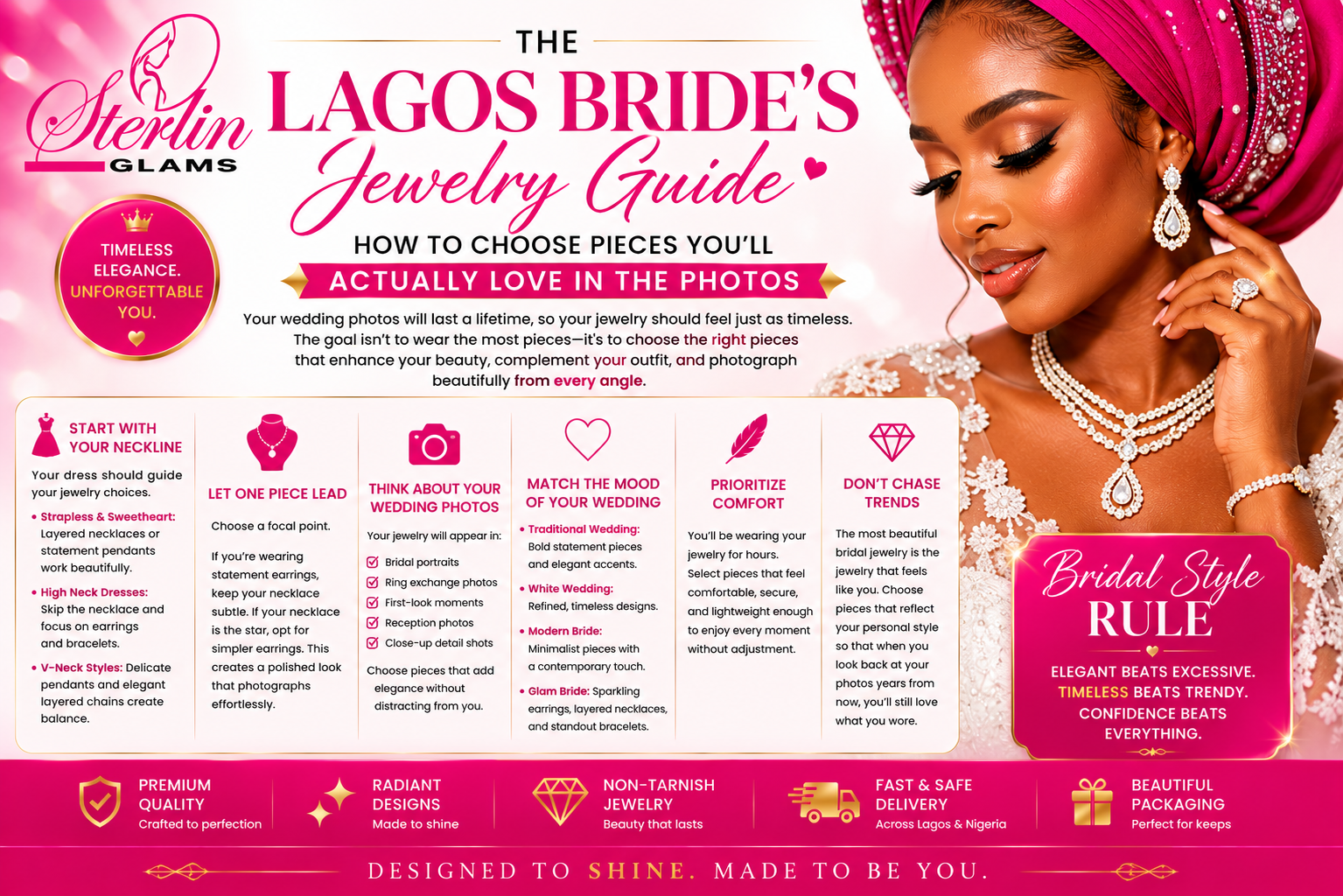
- One hero piece. Either an elegant necklace or a pair of statement earrings not both at full volume.
- Refined supporting pieces. If your necklace is the hero, choose subtle studs. If your earrings are the hero, skip the necklace or wear something very delicate.
- A bracelet your hands can be photographed wearing. Your hands appear in more frames than you’d think the ring exchange, the bouquet, the cake cutting.
For a strapless or V-neck gown, a layered necklace works beautifully. The Silver Layered Tudor Necklace gives you the layered look in a single, photogenic piece, no tangling, no fuss.
For a high-neck or heavily beaded bodice, skip the necklace entirely and let your earrings carry the look. The Rosegold Lattice Earrings or Diamond Glow Stud Earring both photograph beautifully in close-up shots without overwhelming the frame.
The Reception Look
The reception is when most brides finally exhale. The vows are done, the photographs are mostly captured, and now it’s about the dance, the speeches, the food, and the friends.
This is where you can have more fun with jewelry. The lighting is forgiving, the photos are candid, and you’re moving. Bold pieces work.
Reception jewelry favourites among Lagos brides in 2026:
- A stoned set like the Aura Trio, which you can wear complete or break apart
- Stacked bracelets including the 6MM Gold Ball Bracelet
- A statement ring like the Empress Purple Stone Ring for the speeches and dance floor moments
- Sometimes a complete outfit change to a second dress, which deserves its own jewelry story entirely
The Questions Every Lagos Bride Should Ask Before Buying
Before you commit to any bridal piece, run it through these five questions:
- Will I see this clearly in my photographs?
Test it. Take a phone photo wearing the piece. If it disappears, it’s too delicate for bridal. If it overwhelms your face, it’s too much.
- Does it fit the scale of my outfit?
A delicate chain disappears against a heavily embellished gown. A massive bib necklace fights a beaded bodice. Match weight to weight.
- Will I wear this again after the wedding?
This question changes how brides shop. Pieces you’ll wear to anniversaries, dinners, and future occasions are worth investing in. Pieces destined for storage after one day are not.
- Does it photograph well at close range?
Wedding photographers shoot close-up. Macro detail on your hands and ears matters more than the overall effect from across a room.
- Have I tested it with my makeup and hair?
Big lashes and elaborate updos change how earrings sit. Heavy makeup changes how necklaces frame the face. Don’t make final jewelry decisions before your makeup trial.
Common Lagos Bridal Jewelry Mistakes (And How to Avoid Them)
Mistake 1: Buying jewelry too early. Some brides choose jewelry before the dress is finalised. By the time the dress arrives, the jewelry doesn’t suit it. Wait until the dress is in your hands.
Mistake 2: Borrowing pieces that don’t fit your frame. A friend’s beautiful set that’s too long, too heavy, or too dramatic for your bone structure will not save you money. It will date your photos. Borrow if it suits you. Buy if it doesn’t.
Mistake 3: Saving the best piece for “after.” Brides sometimes hide their most beautiful jewelry for the reception, then run out of time to wear it properly. If you love a piece, wear it during the moments that get photographed most — usually the white wedding ceremony.
Mistake 4: Forgetting the bridal party. Coordinating your jewelry with your maid of honour or chief bridesmaid creates beautiful photograph moments. It doesn’t have to be matching — complementary works just as well.
Mistake 5: Skipping the bracelet. Photographers shoot hands constantly during weddings. A bare wrist looks unfinished in close-ups. Even a delicate piece like the Mini Ball Bracelet stacked with a watch makes a difference.
Where to Shop for Lagos Bridal Jewelry
The honest answer: split your sources.
For statement bridal pieces — invest in quality. This is not the moment to discover a new Instagram seller you’ve never tried. Buy from brands you can visit, return to, and trust. Sterlin Glams’ stores in Abuja, Ikeja and Ikota offer that you can hold pieces, see how they catch light, and try them on with your trial makeup. Browse the bridal sets collection or the full jewelry catalogue online.
For accent and supporting pieces — you have more room to experiment. Bracelets, simple earrings, layering chains can come from a wider range of sources.
For traditional bridal beads and corals — specialist vendors are usually the right call. These are categories where craftsmanship matters and online photos can be misleading.
The bride who’s least stressed on her wedding day is the one who consolidated her jewelry sourcing to two or three trusted brands instead of ten.
When to Start Shopping for Bridal Jewelry
Most Lagos brides leave jewelry shopping too late. The sweet spot:
- 4–5 months out: Start browsing. Don’t buy yet. Get a sense of what’s available, what’s in stock, what catches your eye.
- 3 months out: Make your big-piece decisions your hero necklace, your statement earrings, your bridal set. These often need to be ordered or held.
- 6–8 weeks out: Finalise supporting pieces. Bracelets, layering chains, anything for the reception look.
- 2 weeks out: Final fittings with all jewelry on, with your makeup and hair as close to wedding-day as possible.
Last-minute jewelry shopping leads to compromises. The bride who buys her set the week before the wedding rarely loves it as much as the bride who chose hers three months ahead.
The Pieces You’ll Still Love at Your Tenth Anniversary
Here’s a quiet truth most bridal guides skip: the most photographed jewelry isn’t always the jewelry you’ll cherish.
The bride who chose a dramatic set for the photos sometimes never wears it again. The bride who chose something slightly more restrained pieces that suit her actual taste keeps wearing them. To anniversaries. To dinners. To her sister’s wedding three years later.
Bridal jewelry should photograph well. But it should also feel like you. That’s the piece you’ll reach for in five years and smile.
If you’re starting your bridal jewelry search, browse our complete bridal sets collection, explore new arrivals, or visit our Abuja, Ikeja and Ikota stores to see pieces in person. We’re happy to help you build looks for traditional, white, and reception one careful decision at a time.