


Blog
Yoruba Bridal Jewelry: How to Style Your Introduction, Traditional Engagement, White Wedding, and Reception

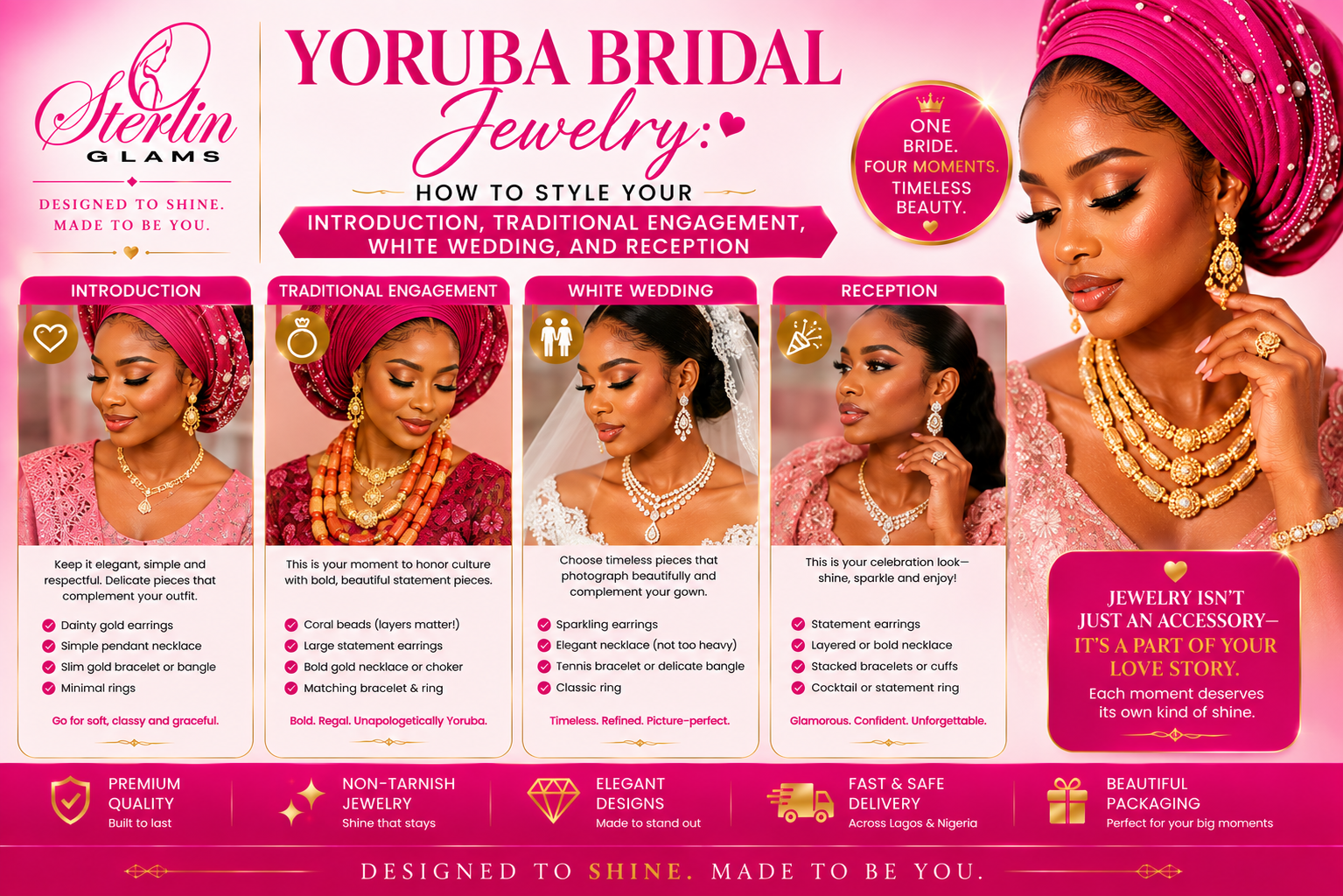
The Yoruba Wedding Is Not One Event. Your Jewelry Shouldn’t Be Either.
Every Yoruba bride learns this quickly.
“The wedding” is not a day. It’s a series. Introduction. Traditional engagement. Often a white wedding. A reception. Sometimes an after-party. Each event has its own energy, its own attire, and — importantly — its own jewelry story. Coverage on BellaNaija Weddings documents this pattern in almost every Yoruba wedding feature: four distinct chapters, four distinct visual identities, four distinct sets of choices to make.
Trying to make one jewelry story work for all of them is where regret begins. The Yoruba bride who plans well thinks in chapters.
This guide walks through each chapter — with practical guidance on coral, gold, aso-oke coordination, gele considerations, and the specific pieces you’ll actually reach for years after your wedding day. It sits alongside our broader Nigerian bridal framework, and goes deeper into the specific decisions the Yoruba bride faces.
Understanding the Yoruba Wedding Structure
Four events. Four distinct jewelry stories. Here’s what each demands.
Introduction (Mo mi ni Mo mo e)
The formal meeting between the two families. Often held at the bride’s family home. Attire is refined but not elaborate — usually a coordinated aso-oke or lace outfit chosen with the family. Jewelry is present but restrained: earrings that read on camera, a single considered necklace, a modest bracelet or two. This is not the moment for the heaviest pieces — save those for engagement day.
Traditional Engagement (Idana or Igbeyawo)
The heart of the Yoruba wedding. The bride’s most elaborate outfit — often layered aso-oke, buba and iro, coordinated gele, and family-provided ceremonial pieces. This is where Yoruba bridal jewelry expresses itself in full. Multi-strand necklaces, statement earrings, layered bangles, coral pieces, hair adornments coordinated with the gele. Every decision made about jewelry for this event will appear in hundreds of photographs.
White Wedding
The Church or civil ceremony. Western-influenced dress — often a white gown with veil — and refined jewelry that complements rather than competes. The visual vocabulary inverts: less layering, less coral, more restraint. One hero piece (usually statement earrings), refined supporting pieces, considered hands and ears because they photograph most.
Reception
The celebration. The bride often changes into a second outfit — sometimes a third. Jewelry can be more expressive, more colourful, more personal. This is often where the pieces you’ll wear again long after the wedding get their first outing.
Traditional Engagement Jewelry: The Idana Look
This is where Yoruba bridal jewelry demands the most planning — and where most brides need the most guidance.
The Role of Coral and Beads
Coral (iyun) carries centuries of significance in Yoruba culture. Historically worn by royalty and reserved for ceremonies of importance, coral remains one of the most recognisable elements of a traditional Yoruba bridal look. Multi-strand coral necklaces, coral bangles, and coral or bead headpieces coordinated with the gele feature in nearly every traditional Yoruba wedding.
A note on coral specifically: it is often family heirloom material. Before buying, ask your mother, aunts, and grandmothers what pieces the family already has. Many Yoruba brides discover they’ve been standing next to their traditional jewelry their whole lives. Family coral often carries more weight — literally and emotionally — than newly-purchased pieces.
Modern Yoruba brides increasingly mix traditional coral with contemporary gold statement pieces from curated brands. The two conversations sit alongside each other rather than competing.
Gold as the Second Pillar
Gold is the workhorse metal of the Yoruba bridal look. Statement gold necklaces, layered bangles on both wrists (often in odd numbers — three, five, seven), heavy earrings, and rings feature prominently. The Idana look layers generously within tasteful limits — enough to feel ceremonial, not so much that pieces fight each other.
Aso-Oke Pairing
Traditional aso-oke is woven fabric, often shot through with metallic thread — gold, silver, copper, or coloured threads that catch light. This changes what jewelry can do.
Delicate chains and small earrings disappear against aso-oke. The fabric has dimension; the jewelry must match. This is the moment for pieces with scale, sparkle, and confident presence.
On colour: all-gold jewelry with gold-thread aso-oke can read flat in photographs. Consider mixing metals or adding coral to introduce contrast. Silver or rose gold accents against gold aso-oke often produce the most striking photographs.
Gele Coordination
The gele is often taller than the bride’s face and dominates her upper silhouette. This has two immediate implications for jewelry choices.
First: high-set necklaces get lost near the neck and chin. Chokers and short chains disappear against the gele’s height. Statement pieces that sit on the collarbone or below tend to photograph better.
Second: earrings become the dominant framing element for the face. With the gele towering above and rising to the sides, the ears become the eye’s landing point in nearly every close-up photograph. This is where to invest most heavily in statement earrings — the piece your future self will notice first in every wedding photograph.
Working with Aso-Oke and Gele: The Rules That Save Photographs
Every experienced Yoruba wedding photographer will tell you the same things. These rules save jewelry photographs from silent regret.
- Match jewelry weight to fabric weight. Heavier aso-oke needs heavier jewelry. A dainty piece against an embellished fabric bodice reads as an oversight.
- Colour coordinate — don’t colour match. Introducing a second metal or coral adds photographic dimension. All-gold on all-gold, without contrast, tends to disappear on camera.
- Test with the gele on. Try jewelry on with the gele tied and secured — not just standing without it. The proportion changes completely.
- Photograph before the day. Take pictures with your phone during trials. What looks perfect in the mirror can vanish or overwhelm on camera.
- Consider your ear-to-gele distance. Tall geles push visual weight away from the face; earrings need to compensate with scale.
- Coordinate to the aso-oke’s dominant thread colour. Not the base fabric — the thread. That’s where the light catches.
Traditional Yoruba Bridal Piece Categories
The specific pieces that build a complete Idana look.
Ileke (Bead Necklaces)
Multi-strand beaded pieces — coral, agate, or precious stone beads. Family often provides these; some modern brides commission new versions from bead specialists in Lagos, Ibadan, or Osun. Layered ileke often serves as the visual centre of the traditional look.
Statement Earrings
The most visible jewelry piece in Yoruba wedding photography — because the gele frames the face and directs the eye to the ears. This is where to invest most heavily. Browse the Sterlin Glams earrings collection for statement pieces that work with aso-oke scale.
Bangles (Wrist)
Yoruba tradition often features multiple bangles per wrist, sometimes across both wrists. Odd numbers are traditional (three, five, seven per wrist). Gold dominates, though many modern brides mix metals or introduce coral bangles for contrast.
Rings
Both the engagement ring and traditional rings for family or ceremonial significance. Some Yoruba brides wear multiple rings on both hands during the engagement, then simplify for the white wedding.
Hair and Gele Adornments
Hair pins, headband pieces, or ceremonial ornaments that work with the gele. These are often coordinated with the necklace and earrings for a unified upper-body look.
Waist Beads
A traditional Yoruba element, worn under the outfit. Not always visible, but part of the complete bridal styling for many brides.
Transitioning from Traditional Engagement to White Wedding
Many Yoruba weddings hold the engagement and white wedding on the same day, or on consecutive days. The jewelry transition is real — and requires planning.
The move is from heavy, layered, expressive jewelry to elegant, refined, restrained pieces. Trying to wear the same jewelry through both events almost always disappoints — the pieces either overwhelm the white dress or disappear against the aso-oke.
Plan two distinct jewelry looks. Coordinate them philosophically (same metal family, same design sensibility) but not literally.
The White Wedding Look
The rules invert.
- Restrained rather than elaborate. One hero piece — usually statement earrings — with everything else refined.
- Coordinate with the dress. Beaded bodice? Delicate or no necklace. Simple silhouette? A statement necklace can lead.
- Consider the veil. Long veils frame the whole silhouette; jewelry needs to work in three dimensions. Test with the veil on before finalising.
- Comfort matters more here. The white wedding often runs longer than the engagement. Choose pieces you can actually wear for six-plus hours without adjusting.
- Hands photograph constantly. Rings and bracelets appear in every ring exchange, ring detail, and dance-floor shot. Don’t neglect them.
Reception Jewelry
The chapter where the bride finally exhales.
Reception outfit changes often demand new jewelry choices. This is where more expressive, more colourful, more personal pieces come forward. It’s also where the pieces you’ll wear long after the wedding — to a friend’s engagement party, to Christmas service, to your first anniversary dinner — often live.
Bold statement earrings, layered necklaces, expressive rings. This is often the moment to invest in the piece that will define your post-wedding jewelry personality.
Yoruba Bridal Train Coordination
Coordinated, not matching. Your maid of honour and chief bridesmaid can echo your jewelry direction without duplicating it. Same metal family, complementary pieces, or shared design language works far better than identical sets across the bridal party.
For coordinated bridesmaid jewelry, our sets collection offers pieces that share a design language while remaining distinct enough for each bridesmaid to feel individually styled.
Common Yoruba Bridal Jewelry Mistakes
- Overloading the traditional look with pieces that don’t coordinate. More is more, but not everything at once. Edit.
- Ignoring how the gele changes proportion. Choosing jewelry without the gele on is choosing blind.
- Skipping the trial with the actual outfit. Every piece should be tried on with the aso-oke or lace it will accompany.
- Buying jewelry before the aso-oke is finalised. The fabric dictates the jewelry. Not the other way around.
- Choosing all-gold when all-gold with gold aso-oke will read flat. Introduce a second metal or coral for contrast.
- Forgetting to check what family already has. Coral, in particular, is often family heirloom material. Ask before buying.
- Buying the same jewelry for the traditional and white wedding. Different outfits, different rules, different jewelry stories.
Where to Shop for Yoruba Bridal Jewelry
Multiple channels play different roles in the complete Yoruba bridal look. Our national buyer’s guide covers the full framework; for Yoruba brides specifically, the following channels serve different needs.
- Curated boutique brands — for statement earrings, modern gold pieces, refined white wedding jewelry, and reception pieces.
- Specialty coral vendors — often in Lagos Island, Ibadan, or through family connections. Best channel for authentic iyun.
- Traditional gold sellers — for classic gold bangles and heavier pieces. Balogun on Lagos Island remains the reference market.
- Custom orders — for very specific traditional pieces or modern-traditional hybrid designs. Some boutique brands offer bespoke work.
- Family heirlooms — often the most meaningful pieces in the entire bridal look. Coordinate this early.
Where Sterlin Glams Fits for Yoruba Brides
Our collection serves the modern Yoruba bride across her white wedding and reception looks — with pieces that also coordinate beautifully with traditional attire. Statement earrings designed to hold their own against gele proportion. Layered bangles that pair with traditional gold. Bridal sets that break apart into pieces you’ll wear beyond the wedding.
We’re not coral specialists — family and specialty vendors serve that need better. But for modern gold pieces that complement your traditional coral and aso-oke, our collection is designed for exactly this. Our stores in Ikeja, Ikota, and Abuja offer bridal consultations. Book with dress fabric samples and gele reference photos. Call 0806 425 0597. If you’re shopping from outside our store cities, our online catalogue at sterlinglams.com ships nationwide.
The Yoruba Bride’s Jewelry Legacy
Here’s what most brides don’t fully appreciate until years later.
The jewelry your grandmother wore for her wedding still exists. In many Yoruba families, coral pieces have been worn by three generations of brides. Statement gold earrings from your mother’s wedding sit in your grandmother’s box, waiting for your daughter. This is not accidental.
Yoruba bridal jewelry, when chosen well, becomes heritage. Not every piece will make it — but the ones chosen with care almost always do. This is worth remembering when you’re standing in a boutique deciding between something distinctive and something safe.
The pieces you’ll wear on your wedding day are also the pieces your daughter may wear on hers. Or your niece. Or your granddaughter. Choose with that mindset, and even the modern purchases become future heirlooms.
This post sits within our broader bridal series. If you’re planning your Yoruba wedding, start with our Nigerian bridal jewelry framework for the cross-ethnic principles that shape every Nigerian bridal decision. Upcoming posts will cover Igbo bridal jewelry (Week 7) and wedding rings in Nigeria (Week 8) — each with the same depth of practical guidance.
Ready to plan your Yoruba wedding jewelry? Browse the Sterlin Glams bridal sets and statement earrings online, or book a consultation at our Ikeja, Ikota, or Abuja store. Call 0806 425 0597.
Frequently Asked Questions
What jewelry does a Yoruba bride wear?
A Yoruba bride typically wears different jewelry for each wedding event. For the traditional engagement (Idana): multi-strand coral or bead necklaces (ileke), statement gold earrings, layered bangles on both wrists, rings, and gele-coordinated hair adornments. For the white wedding: refined statement earrings, delicate necklace or none, considered rings and bracelets. For the reception: more expressive personal pieces.
Do you have to wear coral at a Yoruba wedding?
Coral (iyun) is traditional and deeply significant in Yoruba culture, particularly for the traditional engagement ceremony. However, it’s not strictly required — many modern Yoruba brides pair traditional pieces with contemporary designer jewelry. Consult your family; some families have specific expectations, and coral is often family heirloom material you may already have access to.
How do you coordinate jewelry with aso-oke?
Match jewelry weight to fabric weight — heavy aso-oke needs statement jewelry. Coordinate colours without matching them exactly (introduce a second metal or coral for contrast). Test everything with the actual outfit on, including the gele. Photograph trials with your phone to see how pieces read on camera. Delicate chains and small earrings usually disappear against aso-oke.
Can you wear the same jewelry for the traditional and white wedding?
Almost never. The two events call for opposite jewelry vocabularies — heavy and layered for the traditional engagement, refined and restrained for the white wedding. Trying to make one set work for both usually means it overwhelms the white dress or disappears against the aso-oke. Plan two distinct jewelry looks.
What’s the most important jewelry piece for a Yoruba bride?
Statement earrings. Because the gele frames the face and directs the eye to the ears, the earrings become the dominant jewelry element in nearly every wedding photograph. This is where to invest most heavily — the piece your future self will notice first in every wedding image.
How do I coordinate with my Yoruba bridal train?
Coordinate philosophically, not literally. Same metal family, complementary pieces, or shared design language works better than identical sets. Your bridesmaids should feel individually styled while echoing your bridal jewelry direction.